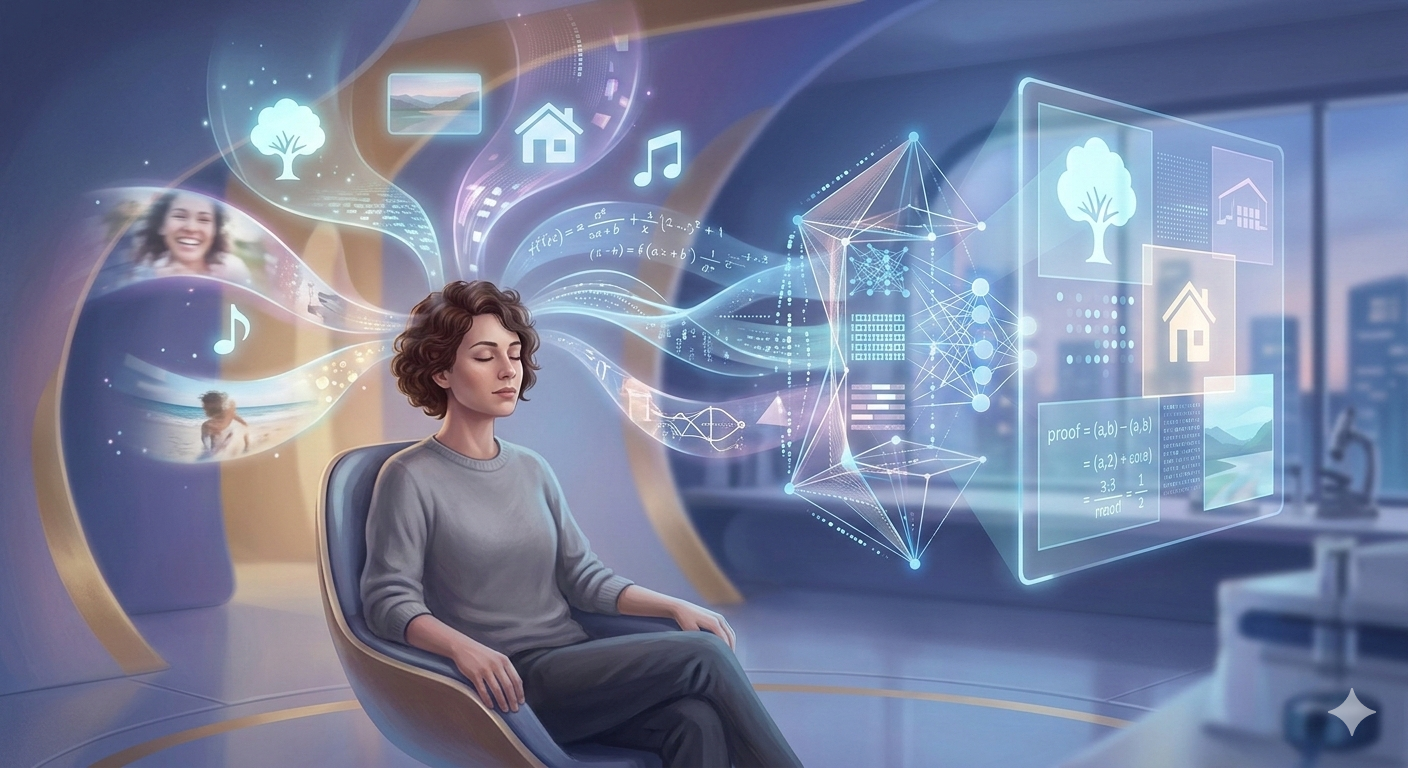

Inside your brain, billions of neurons fire every second. They create patterns of electrical activity that form your thoughts, your memories, your private inner voice. For a long time, these signals were too complex for anyone to decode. That is changing. Artificial intelligence is now giving scientists a window into the human mind. From translating imagined speech to recreating images people see, AI is unlocking the secrets of our brains. Here is how it works and what it could mean for all of us.
Giving a Voice to Those Who Cannot Speak
Imagine being unable to speak but having your thoughts appear on a screen. That is now possible for some patients. In a study at Stanford University, a 52-year-old woman who had been paralyzed by a stroke 19 years earlier took part in a remarkable experiment. She had a tiny array of electrodes surgically placed in the front part of her brain. These electrodes picked up signals from her neurons as she imagined saying words. An AI system translated those signals into text on a screen in real time.
This technique, called a brain – computer interface, allowed her to communicate using only her thoughts. The researchers achieved up to 74 percent accuracy in decoding imagined sentences. While still imperfect, it was the closest scientists have come to true mind reading.
How Brain-Computer Interfaces Work
Brain – computer interfaces have been around in some form since 1969. Early experiments showed that monkeys could learn to control a meter needle using only their brain activity. But decoding speech has always been harder. Speech involves complex patterns across many neurons.
Modern BCIs use tiny microelectrode arrays implanted on the brain’s surface. These arrays record neural activity from specific areas. Machine learning algorithms, a form of AI, are trained to recognize patterns in this activity. They learn which neural signals correspond to different sounds, words, and meanings. Over time, the system gets better at translating thoughts into text or speech.
In 2024, researchers at the University of California, Davis achieved a major breakthrough. They helped a 45 – year – old man with ALS communicate at 32 words per minute with 97.5 percent accuracy. It was the first demonstration that speech BCIs could aid everyday communication.
Beyond Words: Capturing Expression and Emotion
Human speech is more than just words. Tone, pitch, speed, and rhythm all carry meaning. In 2025, the UC Davis team showed they could decode these elements too. Their system allowed a patient to modulate his speech, asking questions with rising inflection at the end of sentences and changing his pitch while speaking. It even captured him singing melodies.
This matters because communication is about expression, not just information. Giving people back their voice means giving them back their ability to convey emotion and emphasis.
Inner Speech: The Thoughts We Don’t Say Out Loud
Most speech BCIs require patients to attempt to say words, even if they cannot physically speak. But what about inner speech, the voice inside your head? The Stanford team tested whether they could pick up these silent thoughts.
They asked participants to count shapes of a certain color in their heads. The researchers detected traces of number words passing through the motor cortex. For imagined sentences, accuracy reached 74 percent in real time. For more open – ended prompts like “think about your favorite movie quote”, the decoded language was mostly gibberish. But the study proved that traces of inner speech can be detected.
Recreating Images from Brain Scans
While some researchers focus on speech, others are working on decoding vision. Using functional MRI scans, scientists can measure blood flow changes in the brain as people look at images. AI algorithms then attempt to recreate what they saw.
In 2023, researchers in Japan used a Stable Diffusion AI model to reproduce images from brain scans. The algorithm was trained on 10,000 photos viewed by four participants. In many cases, the AI produced passable recreations of the original images, though it struggled with objects like a salad bowl.
This work has revealed how the brain processes visual information. The occipital lobe at the back of the brain handles low – level details like layout and color. The temporal lobe behind the temples handles high – level concepts like what an object actually is.
Recreating Music from Brain Activity
Decoding auditory experiences is even harder. Music is constantly changing, but fMRI scanners can only capture images once per second. Despite this limitation, researchers have managed to reconstruct the character and basic category of music people were listening to.
This research has also revealed something surprising. Unlike images, where high – level and low – level information are processed in separate brain areas, music perception blends these elements together. The brain does not separate the meaning of music from its physical properties in the same way it does for vision.
What This Means for the Future
These technologies are advancing quickly. Companies like Elon Musk’s Neuralink are working to bring brain – computer interfaces out of the lab and into commercial use. Within a few years, experts say, these devices could be deployed at scale.
Potential applications go far beyond helping patients. They could recreate the hallucinations of psychiatric patients to better understand conditions like schizophrenia. They could help us understand how animals perceive the world. Someday, they might even reconstruct dreams.
Direct brain – to – brain communication is also on the horizon, though ethical questions remain. Who owns your thoughts? What happens if someone hacks into your brain implant? These are questions society will need to answer.
Artificial intelligence is giving us unprecedented access to the human mind. From translating imagined speech to recreating images and music, AI is decoding the electrical crackle inside our brains. For people who cannot speak, this technology offers a voice. For scientists, it offers a glimpse of a future where the boundary between thought and communication becomes thinner than ever before.


 By
By