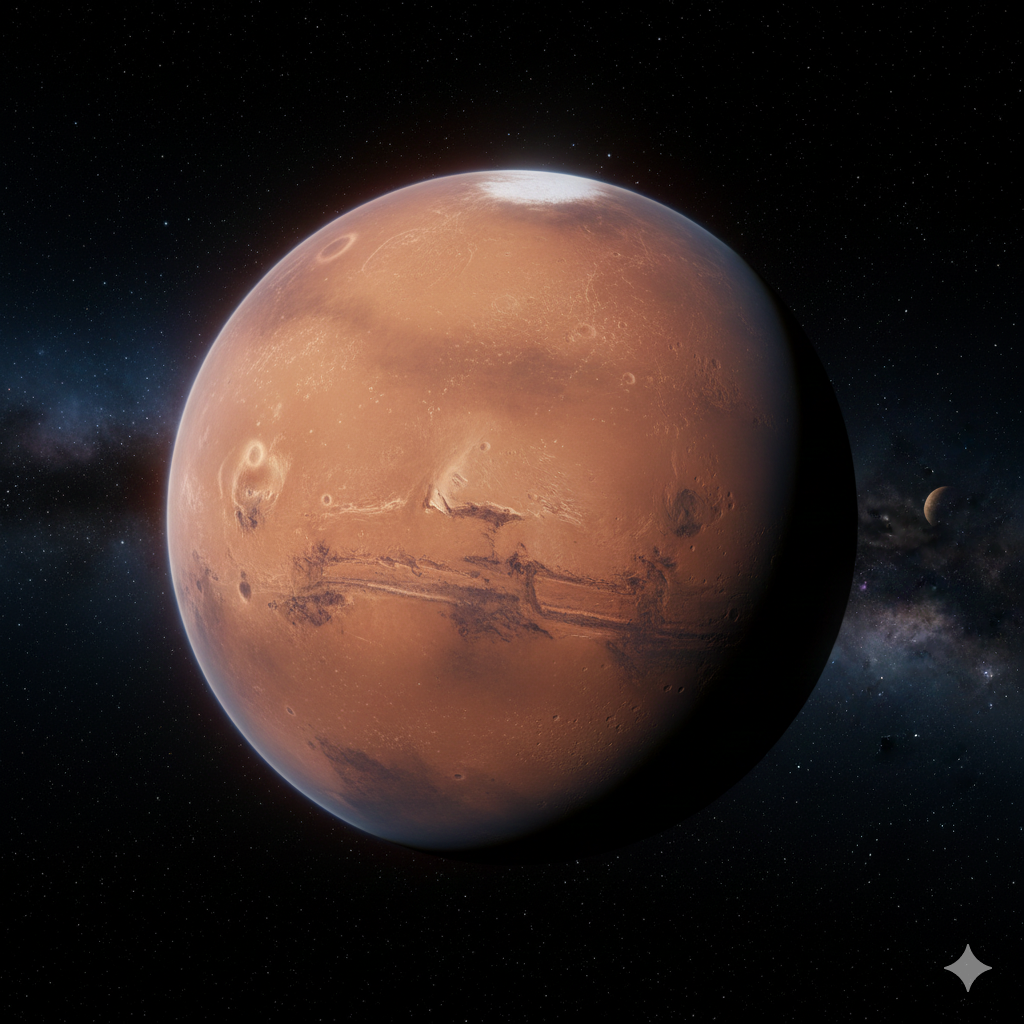

Time doesn’t tick at the same speed everywhere in our solar system. Recent research has confirmed that a clock on Mars would run slightly faster than an identical one an Earth, gaining about 477 microseconds each day. This tiny but crucial difference is due to the unique environment of the Red Planet, a real – world confirmation of Einstein’s theory of relativity.
The main reason is gravity. Mars has weaker gravity than Earth. According to Einstein’s theory, time actually moves slower in stronger gravitational fields. Since Earth’s gravity is stronger, time here ticks a little slower by comparison. Additionally, Mars’s elliptical orbit around the Sun causes small daily variations in this time difference.
While a few hundred microseconds might seem insignificant, this “time drift” has major implications for the future of space exploration. For spices navigation, communication, and scientific experiments on Mars, like a Martian GPS or coordinated networks for astronauts ad rovers, will require incredibly accurate synchronization, making this understanding of Martian time essential.
In essence, as we prepare to explore and eventually inhabit Mars, we must remember that even time itself will be different there – and our technology must be built to keep pace.


 By
By